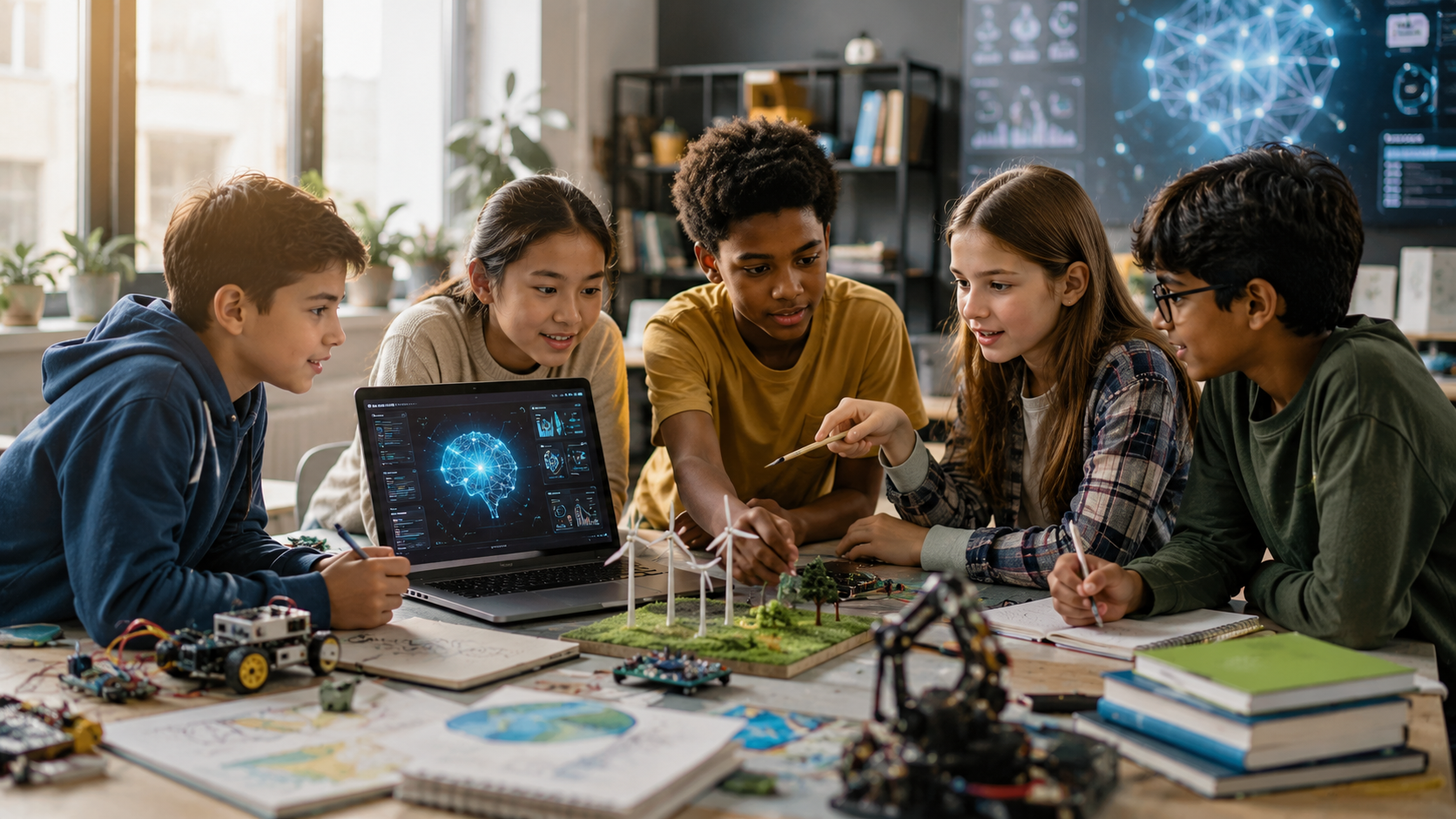
Imagine a child sitting at a desk, attempting to make sense of a complex math problem. They read the question once. Then twice. They do not seem to understand it, however, so they turn to AI for kids for help, asking for it to explain the problem to them in simple terms.
This seems to help a little, but the child still doesn’t understand. They ask the AI again, this time asking it to explain with an example. Suddenly, the child seems to understand.
This is one of the many examples in which AI can be useful in education.
AI doesn’t have to rely on simply answering questions for kids–with the right use, it can help children understand, practice, and even explore their interests and ideas, all through a learning lens.
That does not mean that AI should do the thinking for children, however–it should guide them in a positive direction, and the positive impact that it can have on education will depend on its ability to guide children in their own thoughts, rather than do their thinking for them.
What Does AI for Kids mean?
The concept of artificial intelligence may seem complex at first glance. However, children do not need to be familiar with its technical intricacies to understand its principal definition.
Artificial intelligence can be generally defined as technology capable of perceiving, learning, comprehending patterns, reasoning, and performing other mentally based activities characteristically associated with humans.
Today, children interact with various forms of AI daily. It can be found in search engines, recommendation algorithms, educational software, video games, virtual assistants, programming tools, and numerous other platforms.
Therefore, a critical question that emerges is not whether kids will encounter artificial intelligence. Rather, an additional and more relevant query is how to educate young people to use this technology appropriately.
This technology can be utilized to offer contextual information, practice specific skills, engage in various training activities, and more. Yet, children should be aware that at times, AI may produce inaccurate or even deliberately false information.
For these reasons, literacy in AI is essential nowadays. Understanding how AI for kids works and how to use it responsibly can help children develop the skills they need to navigate an increasingly technology-driven world.
Can AI for Kids mean a More Personalized Learning Experience
Every child learns differently.
For one child, fractions make sense right away. For another, it may take three examples before they understand what a fraction is. Maybe you need a picture to understand it, but another student learns best from stories. One way or another, each student has their own way of learning.
for Example : the kids want to learn about yoga and the benefits of Yoga.
A classroom teacher must address each student individually in a class of 30 students. An AI could help by giving an alternative explanation when a topic doesn’t click for a student.
A student could type in:
“Can you explain photosynthesis like I’m ten?”
Then perhaps ask for an everyday example, or to test them with five questions to check if they learned the concept.
The student could be asking for an explanation that makes sense to them, and an explanation that would be best understood by a five year old. The ability to keep asking for clarification until you truly understand a topic is one of the best tools an AI could offer education.
Researchers and educational institutions are starting to see the value in customizing education to each individual student and the benefits that could come from it. Google announced a project in collaboration with Indian schools that uses an AI to teach preschool children, created with personalized, conversational lessons in mind.
This is one of the key ways AI for kids can support personalized learning by adapting explanations and practice to different learning needs.
AI for Kids Can Make Homework More Helpful
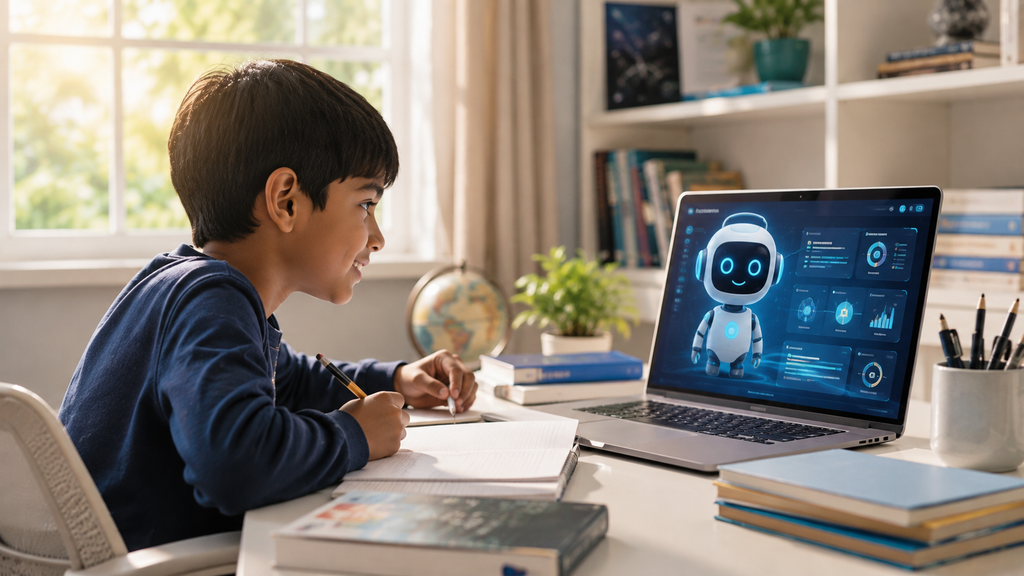
Homework gets frustrating when children get stuck and don’t know where to start.
That’s where AI comes in, but only if you use it as a guide.
Instead of telling an AI to give you the answer to a question, you can tell it to give you a hint but not an answer.
That way, the child will find their own solutions to the problem. The AI does not tell the answer, only helps to get things started.
An example of this could include a student who needs help with a math problem. The AI could explain what it means, give a similar example, or explain how to solve the equation without giving the answer.
This could make AI like a personal tutor. A recent article for parents and teachers even includes this exact idea. It is said that with AI for kids, children could get the assistance they need to begin and fully understand a question, but should not be able to simply give the answer.
The child should not ask for
“do this for me”
but
“help me to understand”
AI for Kids Can Make Exam Preparation More Interactive
Preparing for exams sometimes means reading the same chapter over and over again.
AI would make revising much more active.
A student can ask an AI for a topic and have it generate practice questions, flashcards, multiple choice questions, or a mini-test.
They could even ask it to ask them one question at a time, wait for an answer, inform them if they are right or wrong, and explain what they did wrong if they were.
The student would no longer be passively reading. They would be practicing.
An AI can also help children spot what they struggle on, and if they do poorly on a specific topic, they can ask for a more basic explanation and practice it again.
This makes for a helpful loop of learning, practice, mistakes, understanding, and repeating. And that would be so much more beneficial than learning an answer for an exam.
This is another way AI for kids can make learning more interactive by encouraging children to practice, learn from mistakes, and build a deeper understanding of what they are studying.
AI for Kids Can Help Children Become Better Researchers
Children are naturally inquisitive, asking questions like “why is the sky blue”, “how does a rocket work”, “what would happen if there were no trees”, or “how does the human brain remember things”.
AI can help nurture that curiosity by guiding children through an exploration of the topics related to their questions. It can also help students develop school research projects by leading them through a discovery of what questions they may ask.
For instance, instead of asking for an AI written paper on pollution, a student might ask the AI “what areas should I research if I want to learn about air pollution?” The AI could lead them to the pollution sources, effects on health and the environment, solutions, and case studies in different countries.
The child can then go and research these topics in books, at the library, or on trustworthy websites. That teaches the child a far more valuable lesson than if they just got the answer from the AI.
This helps kids learn how to ask better questions. This is another potential benefit of AI for kids, as it can encourage curiosity and help children develop stronger research and questioning skills.
But Children Also Need to Learn How to Check AI
There is a valuable lesson to be learned here.
AI can make mistakes. Sometimes it can give wrong facts, sometimes it can misunderstand questions, and sometimes it can confidently give an answer with wrong information.
Children need to learn that just because something sounds right does not mean it is right.
This teaches kids an important lesson about research and fact checking. That can lead into a valuable lesson about how to conduct research for school projects.
Parents and teachers can take this opportunity to teach kids a lesson about checking their facts against reliable sources, such as textbooks, teachers, websites, libraries, etc.
AI should be used as a tool to help students with their research, not a crutch to lean on. This is an important part of using AI for kids responsibly and helping children develop strong research and fact-checking skills.
AI for Kids Can Encourage Creativity
Education is not purely the retention of information, it is also giving children a chance to imagine, create, experiment and express themselves. AI has potential to help in all of these areas.
A child who wants to write a story could use AI to get multiple ideas for stories. A student working on a science project could use AI to think of possible experiments. A child could also use AI to help think of ideas for a presentation, game, comic or other project.
There is one rule to keep in mind when helping students create things using AI: the student must be the creator.
Let the AI give ideas, but help them with their own work, rather than making the AI do the work for the student.
For example, if a student wants to write a story about a robot traveling in space, AI could be used to think of ideas for the story line or characters, but the student should be the one who decides what the story should mean and happen.
It’s important that the student is the one who has to think through what they want to create, and how they want it to turn out.
If AI does everything for them, they will just have a completed project at the end. If the child thinks of most of the ideas and AI just helps the student get from point A to point B, the child will have an amazing experience of creating something.
This is one of the most important principles of AI for kids: AI should support children’s creativity without replacing their imagination, thinking, and ability to create.

AI Can Help Children Learn New Skills
AI is not just limited to traditional academic areas.
Children can interact with AI to expand their knowledge beyond standard school subjects.
A child who is interested in programming could ask for clarification on a certain concept or a better explanation for a certain error. A child learning a foreign language could ask the AI for dialogues, vocabulary, sentence structure help, and grammar. A child with a passion for science could ask the AI questions about space, biology, physics, and the environment. A child who likes to write could ask for advice on grammar and structure.
The key aspect of utilizing AI is to hone the skill, not get the end result.
If a child was learning programming, it is better to ask, “Why isn’t my code working? Please explain the error so that I can correct it.” rather than “Fix my entire program.”
The former example would improve the child’s knowledge, while the latter would just fix the problem for them.
This is an important principle of AI for kids: using AI to build skills, understanding, and confidence is more valuable than simply getting the final answer.
What Should Children Learn Without AI?
This is a vital question, isn’t it?
If an artificial intelligence can explain math, compose paragraphs, develop ideas, summarize a book, or answer questions, why should children learn how to do these things?
Because the journey toward an answer is often as valuable as the answer itself. Kids need to know how to read with precision, write clearly, solve problems, retain key information, communicate with others, make decisions, and think critically.
They need to experience frustration and learn how to move past it. They need to make mistakes. They need to engage in meaningful conversation.
They need to read books without first asking an AI to summarize them. They need to write something without first asking an AI to do it for them. And they need to solve a few problems without any help at all.
These challenges and others promote independence.
The real issue with regard to AI and kids isn’t that they should avoid using it, per se. It’s that they should avoid relying on it to think for them. Education theorists are beginning to recognize that the most important debates about artificial intelligence in the classroom involve striking a balance between encouraging independent thinking and using AI to provide helpful support.
For example, AI for kids should make a child more capable, not less.
A Simple Rule for Children: Ask, Understand, Practice, Check and Create
Children do not need a complicated set of instructions for interacting with AI. A simple five step set of directions for using AI is actually quite effective, especially when teaching AI for kids.
1. Ask
Ask a specific question about a topic you are trying to learn about.
2. Understand
Read the response and ask clarifying questions about anything you don’t understand.
3. Practice
Practice solving the problem asked or apply the knowledge you learned in the AI response.
4. Check
Check any information provided that you may have to use or apply later.
5. Create
Finally, create something of your own using the knowledge provided by the AI.
This five step process transforms AI from an answering machine into a learning tool.
AI Safety: What Children Need to Know
Children should also be aware that using AI brings its own responsibilities. The first rule is not to share personal information.
Kids should not share their passwords, home address, phone number, school information, financial information, or anything else that could be considered personal information.
Children should also be aware that talking to AI is not like talking to another human being. They should know that while AI can have a conversation feel to it, it doesn’t mean that the computer knows what is going on in the world or in the child’s life like a parent, teacher, counselor, or trusted adult would.
Another issue surrounding the use of AI is cheating. If a teacher asks that a child complete an assignment on his or her own, using AI to write the paper and then turning it in as his or her own work is not completing the assignment.
Kids should know that if they use AI to help them learn a subject, come up with ideas, or get feedback, it has to be approved by a teacher first. Students should know the difference between getting help and turning in someone, or something else’s work as their own.
These are important lessons when teaching AI for kids, helping them understand not only how to use AI, but also how to use it responsibly.
What Can Parents Do?
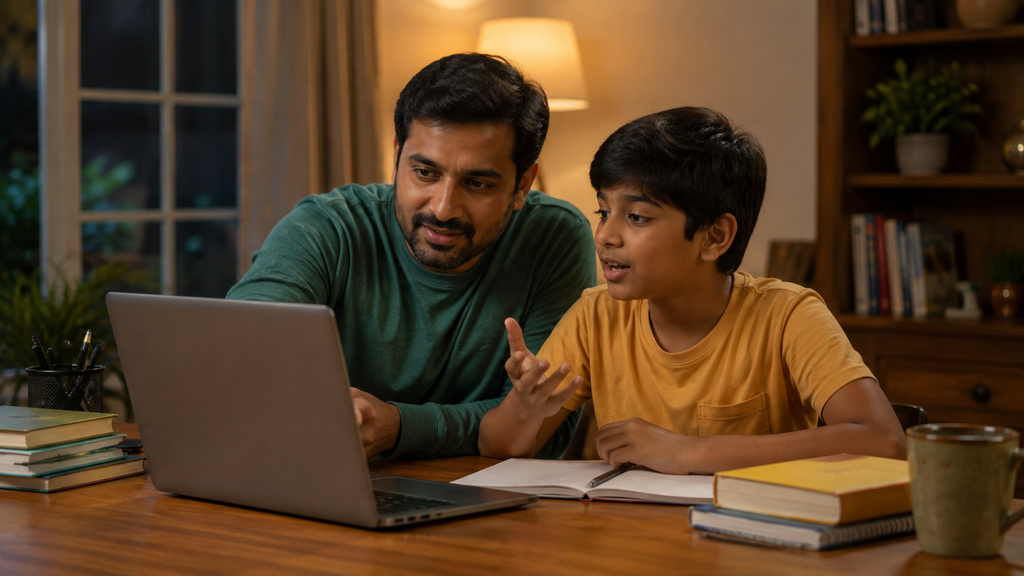
Parents don’t need to become experts in artificial intelligence to help their kids leverage the power of AI. The key is to stay engaged.
Ask your child what they are using AI for; ask them to explain what they learned. If they used AI to work on a school project, ask them to explain the subject in their own words.
That last bit is particularly important. If they can’t explain the answer without AI assistance, then they may not fully understand the answer.
Parents should also set ground rules around using AI, maybe different rules for different ages. Younger kids may need more help, while older kids learn to balance the use of AI with an awareness of privacy, fake information online, cheating, and general digital wellness.
It can also help to think about things like encouraging the child to try first, and have them turn to AI to help them next. Let the kid do the homework problem, write the first draft of something, try to solve the coding problem. Only then turn to AI to help.
That way the child retains that most powerful part of learning: their own work. This is an important principle of AI for kids—AI should support a child’s learning without replacing their own effort.
AI Should Work With Teachers, Not Replace Them
There is this notion that teachers are going to be replaced by artificial intelligence. I think that there is much more to teaching and education than just conveying information.
Teachers connect to their students, they provide encouragement when the student can’t find it themselves, they help to facilitate discussions, they answer questions, they give human feedback, and much more which just cannot be replicated by tech.
Technology could assist with this, or maybe give a bit more insight into certain topics, help to provide additional sources, and offer more opportunities for practice, but there’s still that human connection that only humans can offer.
I think that the best way to approach this situation is that we aren’t trying to put teachers against technology. It’s more along the lines of teachers along with parents and children and technology, because each has a different role to play in the success of the child.
This balanced approach is especially important with AI for kids, where technology should complement teachers, parents, and children rather than replace the human connection at the heart of education.
The Skills Children Need for an AI-Powered Future
Children growing up today will almost certainly come across AI in many areas in their future careers and personal lives. Therefore, they must be taught how to utilize AI in their careers.
But it is not just AI skills that will help them in the future. Because AI produces information and products that cannot always be relied upon, children need to be taught:
- critical thinking
- creativity
- communication
- problem-solving
- curiosity
- most importantly, judgment: the ability to know when to use technology and when to think for themselves
These are some of the important skills that should be developed alongside AI for kids. skills that AI cannot take away from children, and which should be developed alongside AI.
The Future of Learning With AI
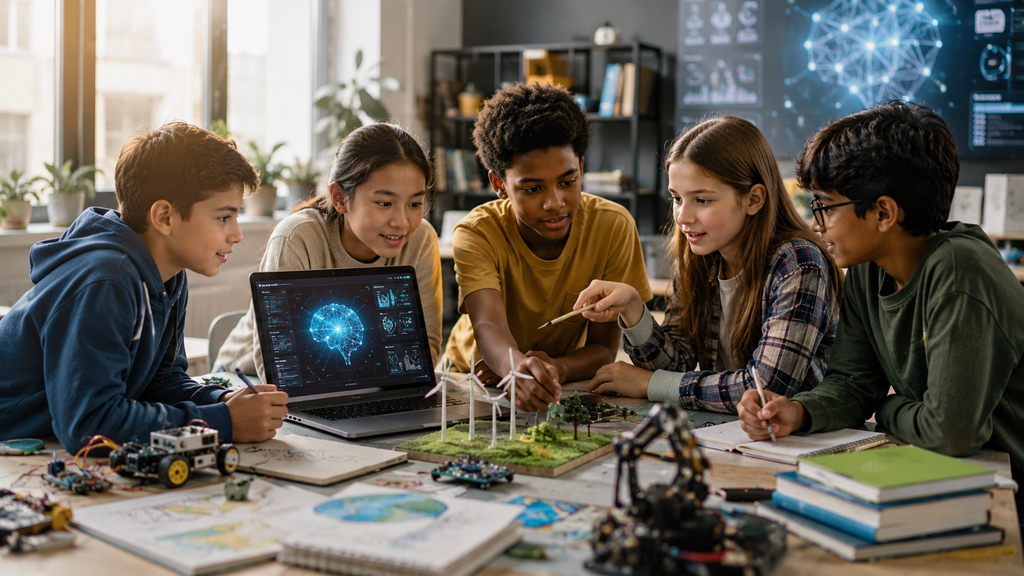
Artificial intelligence is set to revolutionize our world by transforming the way we search, discover, solve, create, and learn. For children, that presents an exciting opportunity.
A difficult lesson can be made easier to understand, a test can become a game of sorts, an answer can be questioned and explored, simple ideas can be taken and stretched to make something new and exciting, and the possibilities go on and on.
But the opportunity goes beyond just exposing children to artificial intelligence; it is also about teaching them how to interact and engage with artificial intelligence.
Children who can formulate better questions, better checks on information, better learning of mistakes made, and more creative uses of technology will have an entirely different relationship with artificial intelligence than children who only ask it to do their work for them.
This is why we cannot simply shield children from artificial intelligence, or alternatively, turn them away from artificial intelligence doing their work for them. The better path is to be somewhere in the middle: allowing children to engage with artificial intelligence in such a way that their own natural curiosity, creativity, critical thinking, and learning is at the forefront of any lesson.
After all, the world of tomorrow does not need children who know how to get answers from artificial intelligence, rather it needs children who know how to ask better questions and what to do with the answers.
That balanced approach is at the heart of AI for kids—using artificial intelligence as a tool to strengthen curiosity, creativity, critical thinking, and learning rather than replacing them.